In brief
This article separates direct evidence from assessment and inference in open-source research. It offers a way to record sources, alternative explanations and confidence before making a business decision. An inference remains uncertain even when it sounds plausible.
Why the distinction matters
Public-source research is full of fragments. A company announces an investment, publishes a vacancy and appears in a supplier case study. The fragments may point in the same direction, but the conclusion still requires judgement. If a report presents judgement as fact, readers cannot test it and may carry an unsupported claim into a high-value decision.
Separating evidence, assessment and inference makes the reasoning visible. It does not weaken the report. It shows precisely where confidence comes from and where additional verification would be useful. This is especially important when technical evidence is incomplete or sources have a commercial incentive to exaggerate. [1][2]
Evidence: what the source directly supports
Evidence is the recorded material available for inspection: a dated annual report, a patent filing, a photograph, a planning record, a vacancy or a product datasheet. The report should describe the relevant content accurately and preserve provenance. A direct quotation may be useful, but paraphrase and source reference are often clearer.
Evidence quality varies. A regulator’s record may be authoritative for a filing date, but not for present operational status. A company or supplier brochure is primary evidence of what its publisher claims, not independent proof that the claim is correct. The right description should be no broader than the source allows. [1]
Assessment: the analyst’s supported judgement
An assessment explains what several pieces of evidence mean when considered together. For example, an approved facility extension, new production roles and supplier commissioning references may support a high-confidence assessment that capacity expansion is under way. The evidence remains separate; the assessment is the reasoned conclusion.
Assessments should state confidence and identify the main basis. Confidence concerns the soundness and stability of the analytical foundation; it is different from the likelihood that a judgement is true. Assessments should also address contradiction. If the company later delays a launch or vacancies remain unfilled, the report should explain how that affects the judgement rather than silently selecting the most convenient sources. [3][2]
- State the specific conclusion being assessed
- Cite the strongest supporting and contradicting evidence
- Explain why sources are considered reliable or limited
- Assign confidence in proportion to the remaining uncertainty
Inference: a plausible step beyond direct support
An inference is a reasonable possibility derived from evidence but not directly established by it. A cluster of hires may indicate a new programme. A supplier relationship may suggest a technical route. A facility change may be consistent with a particular process. These signals can guide strategy and further collection, but should not be repeated as settled facts.
The most useful inference often includes alternatives. If the observed expansion could support either higher volume or a new product line, both explanations should remain visible until another source discriminates between them. This prevents narrative momentum from turning a possibility into certainty. [1][2]
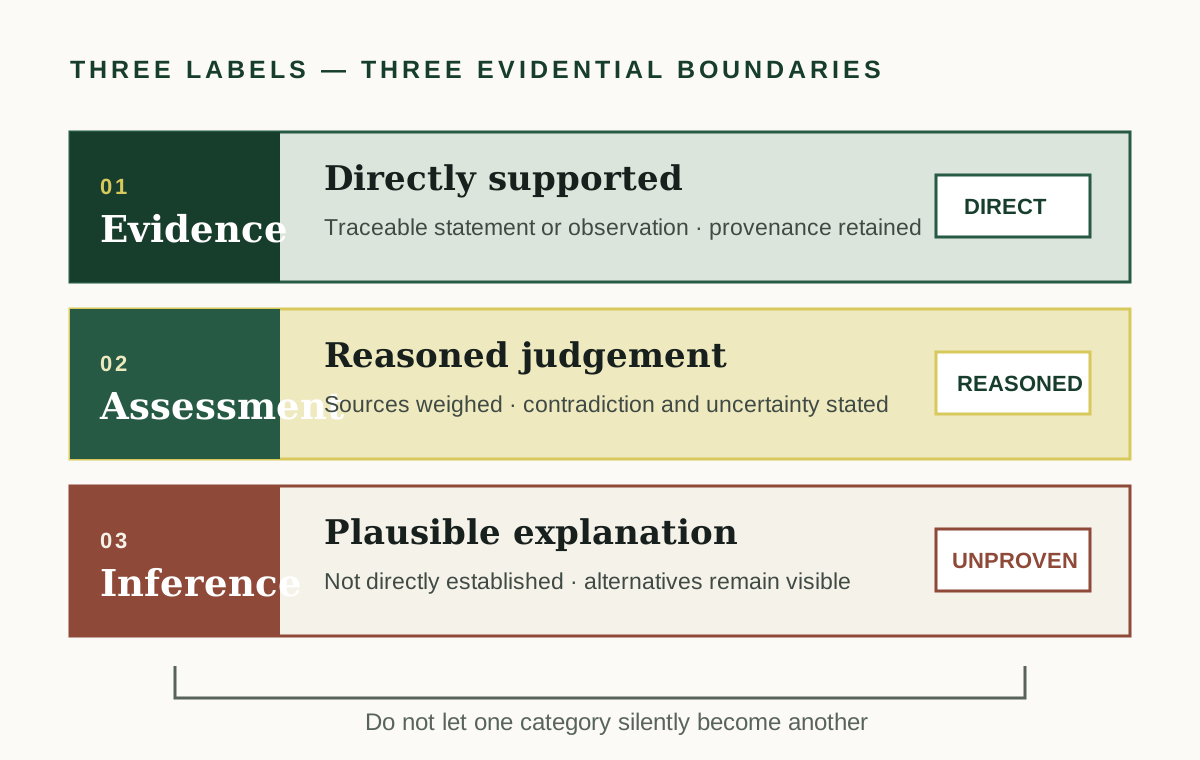
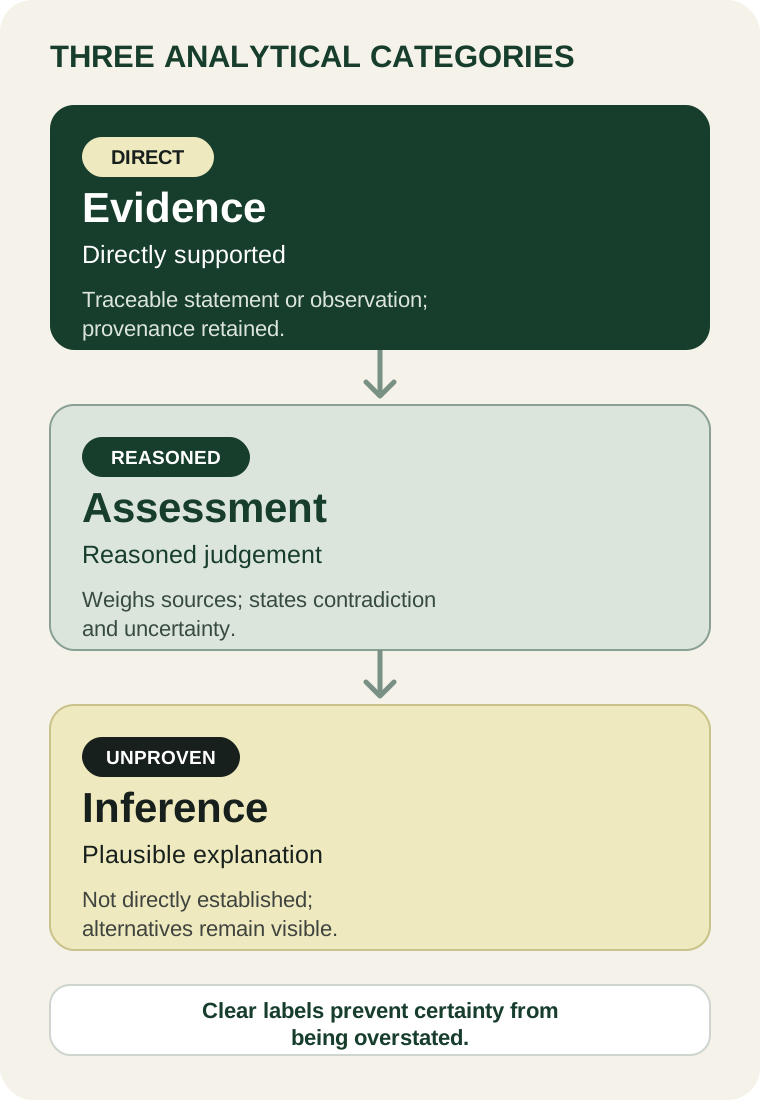
The categories can build on one another, but each needs its own label, evidential basis and limitation.
- Evidence
- A traceable statement or observation supported directly by a source.
- Assessment
- A reasoned judgement that weighs several sources, contradictions and uncertainty.
- Inference
- A plausible interpretation that remains unproven and is tested against alternatives.
Unknowns are part of the answer
Some questions cannot be answered responsibly from public evidence. Production yield, internal cost, customer-specific terms and hidden process parameters may remain unknown. A credible report identifies these gaps and avoids filling them with generic assumptions.
Unknown does not mean useless. It helps a decision-maker understand where risk remains, which claim should not be relied upon and what additional public evidence could improve the picture. The objective is not certainty at any cost; it is a better-calibrated decision.
Begin with a decision and a testable claim
Before collecting sources, write down the decision that the research must support. 'Understand a competitor' is too broad to test. 'Should we treat its announced plant as additional supply for the product we buy next year?' identifies a time period, a product and a practical consequence. It also exposes the assumptions that require checking: whether the facility is intended for that product, whether its process is qualified and whether deliveries have begun. A good research question narrows the evidence search without presuming the answer.
Then define what would count as direct support, what would weaken the claim and what may remain inaccessible. A planning permit can establish permission for a specified development. A company update may establish that management says equipment is being installed. Neither necessarily establishes qualified output. A later product-specific statement, supported by other dated material, may change the assessment. Recording these thresholds at the outset reduces the temptation to move the goalposts after finding an attractive source.
Build a source record that preserves context
A conclusion should be traceable to the material a reader could inspect. For each important item, record the publisher, original location, publication date, date of the event described and the exact statement or visible feature used. Those dates can differ. A report published in September about a planned opening in the following year is not evidence of production in September. Keep the publication's stated scope: a site-wide capacity claim does not automatically answer a question about one component or product line. [2]
Source independence also needs attention. Several articles may repeat the same press release, creating the appearance of corroboration without adding independent observation. A supplier quotation, a company announcement and a news rewrite may all trace back to one interested party. Conversely, a public register may corroborate a location or permit while remaining silent on output. The source record should make those relationships visible, rather than treating every URL as a separate vote for the conclusion.
Test the strongest alternative explanation
A useful assessment asks what else could explain the same evidence. Hiring engineers may support a new production programme, but it might also replace departing staff or support an existing line. A new building may add floor space while production simply moves from another site. Published images may show demonstration equipment rather than machines operating at commercial scale. These alternatives are not reasons to ignore the signals; they are reasons to calibrate the conclusion. [1][2]
Rank alternatives by the evidence available, and state what new observation would distinguish them. A dated commissioning announcement might support progress beyond construction; a product qualification notice may narrow the remaining question; a shipment claim may indicate commercial activity but still need its scope checked. If no public source can discriminate between plausible explanations, keep the result as an inference or an unknown. The honest answer can still tell a decision-maker which assumption carries the greatest risk.
Turn the assessment into a decision-ready record
An executive reader needs a short answer tied to the original decision, not a chronology of every search. State the finding, its confidence, the best supporting evidence, the material contradiction and the consequence if the assessment is wrong. Follow with the source trail so a technical colleague can challenge the reasoning. If evidence supports several outcomes, present the conditions under which each would matter rather than compressing them into a single prediction.
Finally, specify what would trigger a review. A revised company timetable, new regulatory record, product-specific customer statement or verified operating milestone may change confidence. The report need not promise continuous monitoring; it can simply identify the signals worth checking when the decision is revisited. This gives uncertainty a practical role: it determines what to verify next, what not to assume in the meantime and how strongly the current evidence should influence action.
Sources
- Intelligence Community Directive 203: Analytic StandardsOffice of the Director of National Intelligence. Updated 21 January 2022. Accessed 7 October 2026.Government intelligence standard used only for general analytical principles such as source quality, uncertainty, assumptions and alternatives.
- PHIA Common Analytical StandardsUK Intelligence Analysis profession. Published 24 March 2025. Accessed 7 October 2026.Government analytical guidance used here as a methodological reference; it is not an industrial certification for MelonCactus.
- Explaining Uncertainty in UK Intelligence AssessmentUK Intelligence Analysis profession. Published 24 March 2025. Accessed 7 October 2026.Explains the distinction between assessed likelihood and confidence in the analytical basis.
Apply this discipline to a live question.
Define the decision, the evidence standard and the uncertainty that matters most.