In brief
Industrial AI becomes operationally useful when a signal leads through context and accountable decision rights to bounded action. A governed decision loop defines evidence, ownership, approval, fallback and feedback before automation scales. The objective is a traceable decision, not maximum autonomy.
Industrial intelligence closes a decision loop
Industrial intelligence connects operational signals, business context and accountable decision rights to a defined action, then uses the observed outcome to improve the next decision. Analytics can show that something changed. A governed decision loop also states who decides, what the system may do, when a person must intervene and how the result will be checked.
This distinction matters because a dashboard is not an operating decision. A temperature trend, quality deviation or late supplier notice may be accurate and still leave the organisation to assemble context, choose a response, obtain approval and coordinate execution. The useful unit of design is therefore not the model or alert in isolation, but the recurring decision that follows it.
Why dashboards stop at insight
Microsoft describes physical AI as a continuous loop in which systems perceive conditions, reason over context and act within defined boundaries. Its publication also stresses operating limits, observability, fallback and human approval or override when AI affects the physical world. These are Microsoft's design recommendations, not proof that every industrial AI deployment is governed in this way. [1]
A QAD-hosted article makes a related argument: ERP, MES, QMS, EAM or CMMS and historians may each hold part of the operating picture, while a person still reconciles those fragments into a decision. It proposes a decision and orchestration layer around systems already in use. That is a useful architecture claim, but the article is vendor-hosted thought leadership rather than an independent comparison of implementations. [2]
The practical gap is between recognising a condition and owning the consequence. If the system cannot identify the relevant order, asset state, safety rule, available intervention and responsible owner, it has produced information rather than a complete decision path.
Five stages of the MelonCactus Industrial Decision Loop
The MelonCactus Industrial Decision Loop is a simple design test: signal → context → decision → action → outcome. Each stage must have an accountable owner and an evidence boundary. The model does not imply that AI should control every stage; it makes explicit where software assists, where a person approves and where automation is not appropriate.
- Signal: define the event that opens the decision, including thresholds, data quality and false-alarm conditions.
- Context: assemble only the operational and business facts needed to understand the consequence, such as asset history, current order, quality status and an authorised operating limit.
- Decision: name the owner, permitted options, approval level, evidence threshold and escalation rule.
- Action: execute through the system of record or responsible team, with a safe fallback when required information or connectivity is missing.
- Outcome: record what happened, whether the decision achieved its intended result and which assumption or rule needs review.
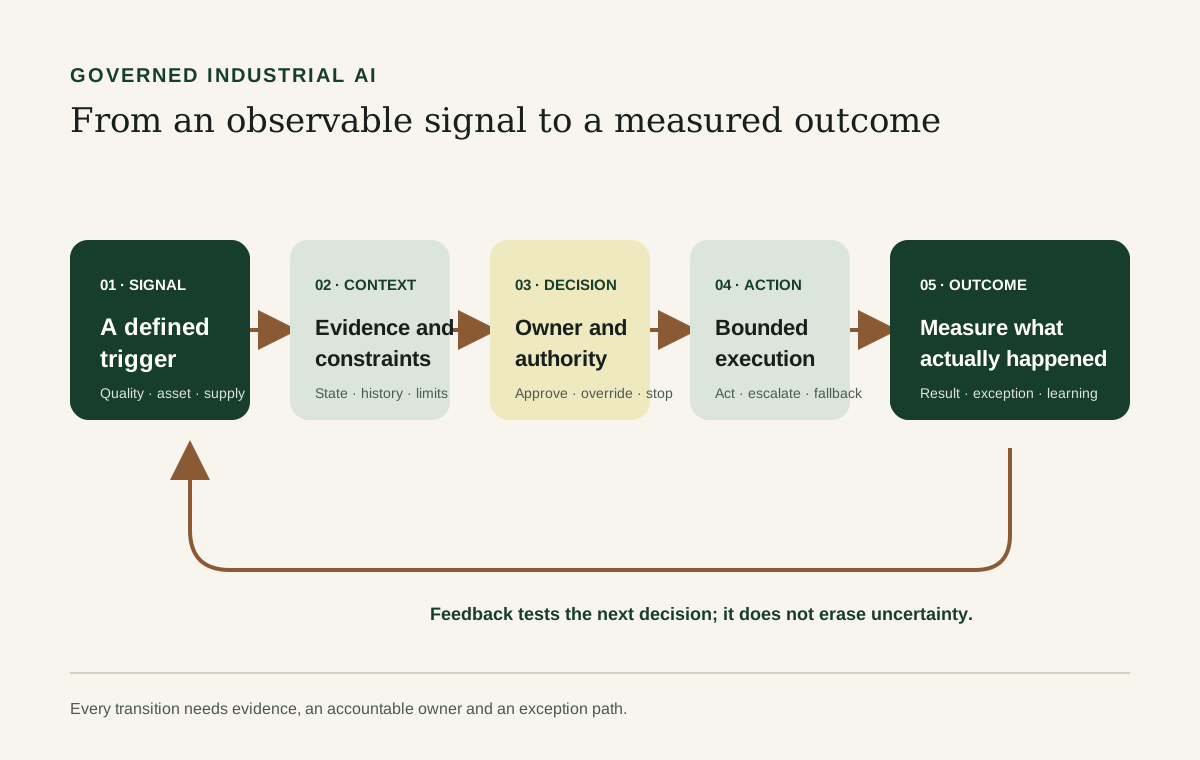
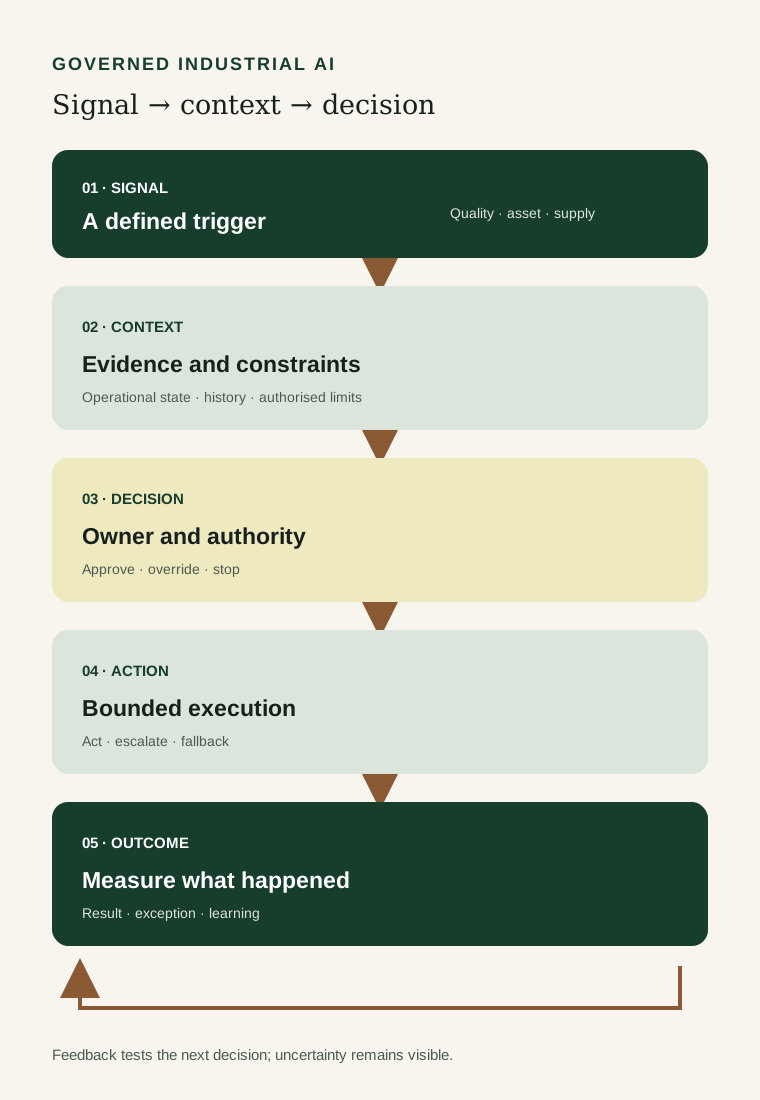
A useful loop connects a defined trigger to context, decision rights, bounded action and measured feedback; it does not treat an alert or recommendation as the finished result.
- Understand
- A signal gains meaning only after relevant operational context and evidence limits are added.
- Decide and act
- Named owners, approval rules and safe boundaries determine what may happen next.
- Learn
- The observed outcome returns to the loop so assumptions and rules can be reviewed.
A bounded maintenance example
Consider a fictional packaging line where a drive temperature rises beyond its normal operating band. The signal alone does not establish a failing bearing, the urgency of intervention or the commercial effect of stopping the line. The system first checks sensor quality, recent maintenance, load, active production order, available spare parts and the approved operating envelope.
Suppose the evidence supports two safe options: reduce load until the current batch completes, or stop for inspection. The maintenance lead owns the choice. The AI may assemble evidence and recommend an option, but it cannot silently widen the temperature limit. If a required sensor is unreliable or the condition moves outside the authorised envelope, the workflow escalates and returns control to the responsible person.
After the intervention, the team records the inspection result, downtime, quality effect and whether the original diagnosis was supported. That feedback can improve a threshold or procedure. It does not prove that the same rule is suitable for another line, drive type or plant without validation.
Recommendation, bounded execution or controlled autonomy?
Infor's 2026.10 release material describes agents that perform routine work inside approval workflows and involve people at decision points that require judgement. Because this is Infor's own product release, it establishes what the supplier says its software is designed to do; it does not independently establish performance or compliance. The underlying governance question remains useful: which actions are reversible, low-risk and explicitly authorised? [3]
Authority should be assigned per decision, not per technology label. The same agent might be allowed to draft a work order, require approval before reserving a production window and be prohibited from changing a safety limit. A written policy is not enough if the workflow cannot enforce it or preserve a decision record.
| Level | What AI may do | Human role |
|---|---|---|
| Recommendation | Analyse evidence and recommend an option | Decide, approve and execute |
| Bounded execution | Perform pre-authorised, reversible actions within explicit limits | Approve the boundary and handle exceptions |
| Controlled autonomy | Decide and execute inside a validated operating envelope | Set policy, monitor outcomes and retain intervention authority |
Five questions before scaling
Microsoft advises starting with one bounded operation and designing a successful pattern so that it can be reused. QAD similarly argues for one recurring decision with definable authority and a measurable outcome. Reuse should follow evidence: a pattern is not transferable merely because two lines use similar equipment. [1][2]
- What exact event opens the decision, and how will missing, delayed or contradictory data be handled?
- Who owns the decision and its operational result, including the cost of a false positive or delayed response?
- Which evidence, rule or person may confirm, overrule or stop the recommendation?
- Which outcome will be recorded, and who reviews whether the intervention actually helped?
- Which context, controls and tests must remain consistent before the pattern is repeated on another line or site?
Start with the decision, not the model
A useful first project is a recurring decision with a clear consequence, an identifiable owner and boundaries that can be stated before automation begins. Map the current path from signal to action, including manual judgement, inaccessible data and exceptions. Only then decide where analytics, an agent or conventional workflow automation adds value.
The goal is not maximum autonomy. It is a decision that becomes more timely, traceable and consistent without hiding uncertainty or transferring accountability to a model. Start with one bounded loop, measure the operational result and expand only when the evidence supports reuse.
Frequently asked questions
What is industrial intelligence?
Industrial intelligence is the disciplined use of operational, technical and commercial information to support a defined industrial decision. It connects evidence to ownership and action while preserving uncertainty.
What is an industrial AI decision loop?
It is a repeatable path from signal through context, decision and action to a measured outcome. Governance specifies the owner, evidence threshold, authority boundary, exception path and feedback.
How is decision intelligence different from business intelligence?
Business intelligence commonly describes performance through reports and dashboards. Decision intelligence focuses on how a specific choice is framed, governed, executed and evaluated. The two can work together.
When should an industrial AI agent require human approval?
Approval is appropriate when an action is safety-critical, difficult to reverse, outside validated limits, based on incomplete evidence or carries material operational, legal or commercial consequences.
How do ERP and MES contribute to industrial AI?
ERP can provide orders, inventory, cost and authority context; MES and other operational systems can provide current production state. Neither automatically creates a governed decision. Their data must be relevant, reliable and connected to an owned workflow.
Sources
- Physical AI in manufacturing: From intelligent machines to coordinated operationsMicrosoft. Published 6 October 2026. Accessed 11 October 2026.Vendor thought leadership. It supports attribution of Microsoft's proposed perceive–reason–act loop and governance considerations; it is not independent evidence that a particular deployment delivers the stated benefits.
- Driving Future-Ready Manufacturing: From ERP to AI-Driven DecisioningQAD. Published 6 October 2026. Accessed 11 October 2026.Vendor-hosted guest thought leadership. It is used for its decision-layer argument and explicit authority boundaries. Adoption figures and example outcomes in the post are not used as independent market evidence.
- Built to execute: AI in the 2026.10 releaseInfor. Published 6 October 2026. Accessed 11 October 2026.Infor product-release material. It is primary evidence of how Infor describes its own approval workflows and agents, not independent validation of their performance, compliance or suitability.
Apply this discipline to a live question.
Define the decision, the evidence standard and the uncertainty that matters most.