In brief
The European Commission's Battery Booster Facility highlights the difficult transition from pilot to commercial battery-cell production. Announced GWh capacity, equipment installation and stable qualified output are different measures. The programme is evidence of a policy response, not proof that an individual factory has reached its target.
Announcements about battery factories tend to feature one large number: planned annual capacity in gigawatt-hours. It can help readers compare ambition across projects. It cannot, by itself, tell a supplier or customer whether the planned cells will be delivered at consistent quality and scale.
The European Commission's Battery Booster Facility announcement of 28 July 2026 is revealing. The Commission opened a call offering up to €1.5 billion in interest-free loans to eligible battery-cell manufacturing projects in the European Economic Area. The cells must be suitable for electric-vehicle applications. The call specifically targets the phase between pre-series production and full commercial operation. The policy addresses a distinct part of industrial expansion: going from an established project and early production to sustained industrial scale.
A GWh figure can describe three different things
Design capacity is the scale a site is intended to support in a future operating state. Installed capacity describes equipment available under certain technical conditions. Realised output is the useful production achieved in a defined period. All three can be expressed with similar units, making it easy to read them as equivalent even when they measure different stages.
The Commission requires, among other conditions, a planned annual capacity of at least 10 GWh. Projects must already be in the ramp-up phase when the call opens and represent the applicant's first full commercial-scale production project for electric-vehicle battery cells globally. The 10 GWh threshold is an eligibility condition for a proposal, not a report of what any applicant is manufacturing today. Technical and financial maturity also feature in the selection criteria. A successful financing decision would therefore still need to be followed by evidence of the specific project's progress.
What happens after the first cells?
Pre-series output can show that a process works in a limited setting. Regular commercial supply calls for repeatable quality, control over process variation, reliable raw materials and proof that the finished cells meet the customer's requirements. Public disclosures do not normally provide complete monthly yield data, so an outside researcher should resist filling those gaps with confidence that the sources do not support.
A vacancy for production staff might point to preparations for scaling. A customer sample might establish availability for assessment. A manufacturer announcing commercial production is a stronger indicator of the project's stage. None alone establishes that the eventual annual GWh target has been reached.
A decision-focused assessment records dates for the initial announcement, investment decisions, pilot batches, customer qualification and any reported commercial shipments. It also labels each source. Where a production milestone comes only from the promoter, attribute it accordingly. A separate official financing announcement may establish support without independently verifying output.
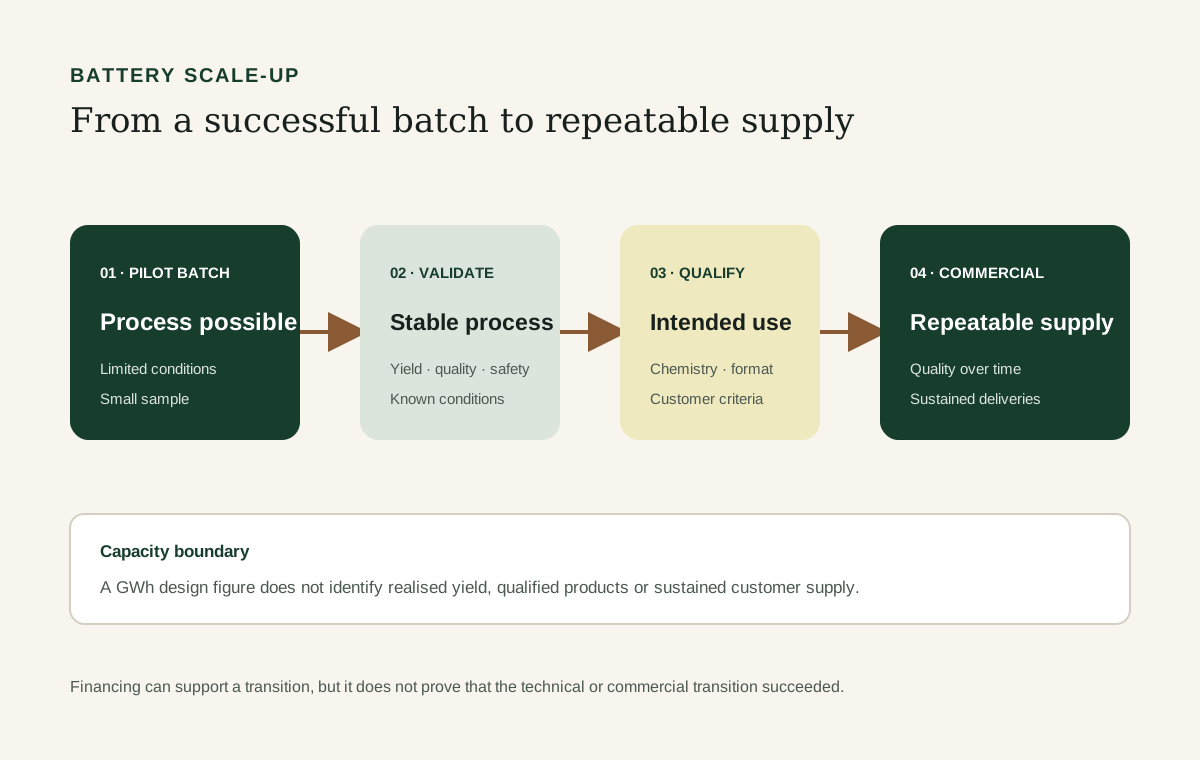
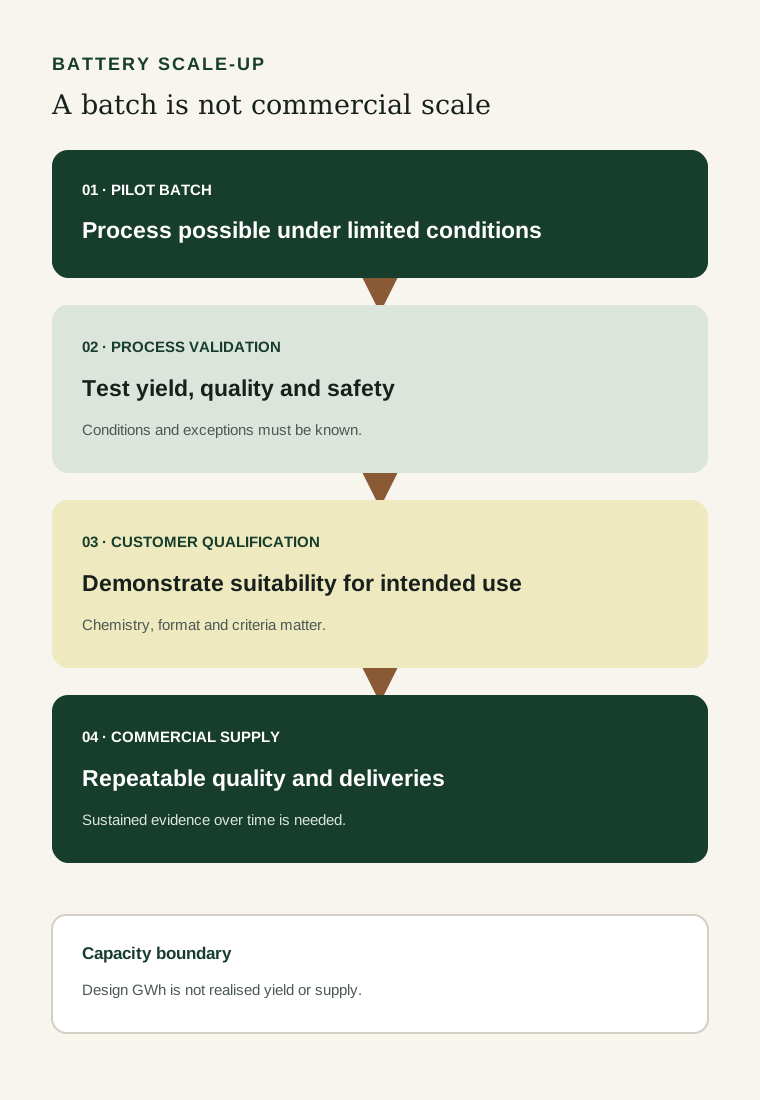
A design-capacity figure or first successful batch does not establish repeatable yield, customer qualification or sustained supply.
- Pilot
- A small batch can show that a process is possible under limited conditions.
- Qualification
- Process stability and product suitability must be demonstrated for the intended use.
- Commercial supply
- Repeatable output, quality and deliveries over time require separate evidence.
Financing has its own evidential limits
The Commission's programme shows that policymakers recognise the funding demands of the ramp-up phase. It does not show that every eligible project has the same technical challenge, that every application will receive support or that financing guarantees a successful factory. The existence of a scheme should never be misreported as an award to an individual manufacturer.
For a supplier, timing matters. Investing solely on the basis of a planned annual figure could be premature. Waiting until a facility reaches full scale could leave too little time to qualify as a supplier. A good evidence timeline helps match each commercial decision to what is currently established, what is plausible and what needs direct confirmation.
The product specification matters as much as the GWh figure. Annual energy capacity tells us little about whether the proposed cells have the chemistry, format and quality standard required for a particular vehicle or application. Link production claims to the actual market for which the factory is designed.
This article does not assess an individual battery manufacturer. Its lesson is how to read project news: planned capacity is an ambition that must be established through a sequence of milestones. The most difficult and commercially relevant questions often arise between the first successful cell and sustained supply.
Internal link: Separating evidence, assessment and inference.
Sources
- Commission seeks projects to fund under Battery Booster FacilityEuropean Commission. Published 28 July 2026. Accessed 12 October 2026.European Commission announcement. It supports the existence, purpose and stated conditions of the funding call; it does not prove an award to a particular manufacturer or successful commercial ramp-up.
Apply this discipline to a live question.
Define the decision, the evidence standard and the uncertainty that matters most.